![[personal profile]](https://www.dreamwidth.org/img/silk/identity/user.png) masterghandalf
masterghandalfBy Dennis L. McKiernan
Alternate Title: The Lord of the Rings: The Off-Brand Version
SPORKER: MasterGhandalf
SUMMARY
In a legendary world that may or may not be our own in the distant past, evil is stirring. An ancient sorcerer tyrant, a disciple of the god of evil, has returned to his fallen kingdom, raised his dark tower once again, and readied his legions for war. In response, a group of unlikely heroes belonging to a short-statured, generally peaceful humanoid race will be called on to go on an epic quest; they will find themselves traversing demon-haunted dwarven ruins, aiding the kings of Men in battle, and eventually must infiltrate the sorcerer’s realm to destroy the artifact that is the ultimate source of his power and prevent the world from falling under an eternal Shadow.
…what do you mean, you’ve heard this one before!?

Introduction
In the late 1970s, a man named Dennis L. McKiernan found himself hospitalized after a car accident. While recovering, he passed the time by writing a fanfic of JRR Tolkien’s The Lord of the Rings, focusing on the story of the dwarves reclaiming Moria from the orcs in the Fourth Age, something LotR’s appendices indicate will happen in the future, but which is a tale Tolkien himself never told. Apparently, his agent and an interested publisher were impressed by the fic and tried to get the Tolkien Estate’s approval to publish it; like a certain Demetrious Polychron decades later, the Estate told them to take a hike. Also like Polychron, McKiernan and his publisher decided to go ahead with it anyway. Unlike Polychron, however, they at least had the sense to avoid a legal battle by dolling the story up as an original setting first. Thus was “Mithgar” born, and it’s totally not Middle-earth at all, we promise! However, because the fic, rebranded as The Silver Call, still clearly followed in the aftermath of a great war between the forces of good and evil, McKiernan’s publisher, Doubleday, wanted him to write that story too to publish first. Thus was born The Iron Tower… and, because it was a prequel to a story that had begun as a fanfic sequel to LotR, the result was perhaps the most blatant LotR-ripoff in a genre that was, at the time, notorious for them, even more than the more famous Sword of Shannara (not at all helping was that while McKiernan seems to have written Iron Tower as one book, Doubleday divided it into three volumes for its initial publication – also mirroring LotR. Later editions, including the one I’m sporking from, tend to restore it to one volume, however). Silver Call would be released not long afterwards.
Iron Tower isn’t an exact LotR clone, however, though it follows the overall plot very closely, even including its own expies of hobbits (“warrows”). However, the internal order of events is reshuffled quite a bit, though when they do happen they tend to hew fairly closely to the originals – the trek through Not!Moria is probably the most exact, unsurprisingly considering the setting’s origin and the story Iron Tower is a prequel to. The story is, however, also shorter than LotR, and therefore somewhat pared down in comparison. And when McKiernan doesn’t pull from LotR itself, he’s not above cannibalizing from other parts of the Legendarium. There is no Saruman expy (a cut Shannara also makes, which I think is a mistake and greatly oversimplifies the overall conflict and the maneuvering on the bad guys’ end) though the Morgoth-expy takes a direct hand in things in a way the actual Morgoth does not in LotR (the setting as a whole, interestingly, also has two Sauron expies, one representing Sauron as the dark lord on his dark throne, the other Sauron as the manipulative shapeshifting necromancer; only the former is relevant in Iron Tower, however). Some elements of the overall conflict, including the initial context of the warrows’ involvement, also seems more closely modelled on the wars with Angmar in LotR’s appendices than the War of the Ring itself. The bones of the story, however, are quite plainly recognizable and can’t really be hidden, and Iron Tower has been routinely mocked for its derivative nature for its entire history in publication.
In any case, whatever their origins, Iron Tower and Silver Call were successful enough that McKiernan was eventually able to retire from his day job as an electrical engineer and work full-time as a novelist. He expanded his Mithgar setting considerably over the years. However, where Terry Brooks of Shannara fame was able to eventually move out from under Tolkien’s shadow (both by emphasizing the setting’s post-apocalyptic roots – no, despite what I’ve seen claimed, that element was present in the Shannara books from the start and wasn’t invented for the TV adaptation – and by mixing in more sci-fi and technological elements into the setting’s present, so that Shannara novels after the original trilogy are as much steampunk as they are medieval fantasy and the setting ends up feeling quite different from Middle-earth) McKiernan was never really able to escape the feeling that he was just writing Middle-earth Lite. Notably, the two Mithgar books that seem to be generally the best regarded, comparatively speaking – Dragondoom and The Eye of the Hunter – are probably the least overtly Tolkien-influenced. Dragondoom starts as a riff on the story of Fram and Scatha the Worm (told in brief in LotR’s appendices) but then develops in a quite different direction; Eye of the Hunter is a smaller-scale story about the hunt for a serial-killer necromancer that has very little overt Tolkien influence at all (beyond the presence of elves and “warrows” among the hunters and the fact that said necromancer is revealed to be the bastard son of the second of the setting’s Sauron-expies). But most of the Mithgar books aren’t so lucky. The Hel’s Crucible duology, which relates Mithgar’s version of the War of the Last Alliance, has a reputation for being particularly dire in my experience.
Part of the Mithgar books’ problem is that while they’re reasonably competent at aping the surface-level elements of the Middle-earth Legendarium, they miss a lot of the deeper nuance that makes the setting work. Rather obviously, while the books span nearly ten thousand years in-universe, they barely seem to have history; while certain individual locations are founded or destroyed across the setting, Mithgar as a whole is quite static and basically the same place at its chronological earliest point as it is by its latest, in contrast to Middle-earth being a radically different place at the end of the Third Age than at its beginning (and is practically unrecognizable comparing the beginning of the First Age to the end of the Third). I honestly wonder how much McKiernan may have contributed to the stereotype of bad fantasy works having lots of history where nothing ever really changes (though David Eddings is also a likely culprit here, especially in the Belgariad). A related element is that McKiernan’s elves are a lot more sue-ish and less interesting than Tolkien’s, their tragic history and the sins of their warlike past being relegated to backstory the books never actually explore and presented as something the elves have outgrown and put behind them long ago, leaving them as being mostly straightforwardly Better Than You. Many of his villains tend to be almost cartoonishly evil in a way Tolkien’s generally are not, and he has a tendency, especially in the later books, to insert philosophical ramblings that are a lot more banal and less impressive than he seems to think they are. Even his prose often feels like trying to ape Tolkien’s writing style, clumsily. While McKiernan does establish elements of Mithgar’s cosmology and the nature of the struggles between its gods that are quite different from Middle-earth’s, it’s never enough to really shake the books’ reputation as a second-rate Middle-earth by a second-rate Tolkien. And as much as McKiernan liked to wax poetic about how he writes about ordinary people, not great destined heroes, there’s reason to argue he largely misses the point of what Tolkien was doing with the hobbits in the first place with how he uses his copyright-friendly “warrows.”
The Mithgar series eventually had its grand finale with Silver Wolf, Black Falcon in 2000; though McKiernan would return to the setting sporadically afterwards, none of those later books made much of an impact, nor did any of his forays into writing outside Mithgar. He’s not published anything, as far as I can tell, since the very last Mithgar novel, Stolen Crown (whose plot bears a certain unmistakable resemblance to the story of the Gondorian Kin-Strife, also told in LotR’s appendices…), in 2014 (and considering he’s now in his nineties, I doubt he will again). Though when I first got into fantasy reading he tended to have fairly significant shelf-space at the bookstores I frequent, these days he generally isn’t present at all, and in discussion in fantasy fan-spaces, while other contemporary writers like Brooks, Donaldson, Eddings, Fesit, Cook, Lackey, Weis and Hickman, etc. still get brought up fairly often, McKiernan mostly seems to be forgotten.
I myself first discovered Mithgar in the early 2000s, when I was first starting to get into more modern fantasy literature (compared to classics like Tolkien, Lewis or Alexander) that wasn’t Dragonlance or Forgotten Realms; a friend with whom I often exchanged books loaned me her copy of Dragondoom. 14-year-old MG, hungry for more books that would scratch that Tolkien itch, would eventually read most of the Mithgar books – the fact that I was introduced to the series with arguably its best entry didn’t hurt. Even then, however, The Iron Tower felt like an oddball, a blatant ripoff that dragged the rest of the series down by the fact of its existence. Of course, I rather quickly outgrew even the relatively better Mithgar books, whose flaws become much more obvious when looking back on the series without nostalgia-colored glasses, and I think they’ve probably aged among the worst of the various major epic fantasy series from the 80s, which is saying something. But my goal here is not to take a look at Mithgar as a whole, but at The Iron Tower and then The Silver Call specifically, to see where it all started – and to continue my journey I’ve been on over the last couple of years through the world of weird Tolkien sequels, spinoffs, adaptations and reimaginings. I hope this journey will be an enlightening one, as we explore in more detail why Tolkien’s version of this story works while McKiernan’s doesn’t. Or at least we might find some amusement in taking a look through yet another work of bad fantasy by an author whose ambitions exceeded his grasp.
I don’t plan to have any specific counters for this sporking, beyond in general keeping track of Tolkienan tropes it uses in general, whether from LotR itself or pulled from elsewhere in the Legendarium, and comparing how McKiernan’s use of them stacks up to Tolkien’s and what the implication of some of his changes are. I will be bringing in some guest sporkers to help with this, of course. If you’ve followed my sporking of Fellowship of the King you’ve already met them; if not, they’re the main characters for an adaptation of the War of the Burning Sky D&D Adventure Path I may or may not get around to writing someday, and you can see a brief look at them here:
Kasanari, elf druid, an exile from a fallen homeland:

Tharkos, half-orc soldier, a renegade from an empire that is no longer what it once was:

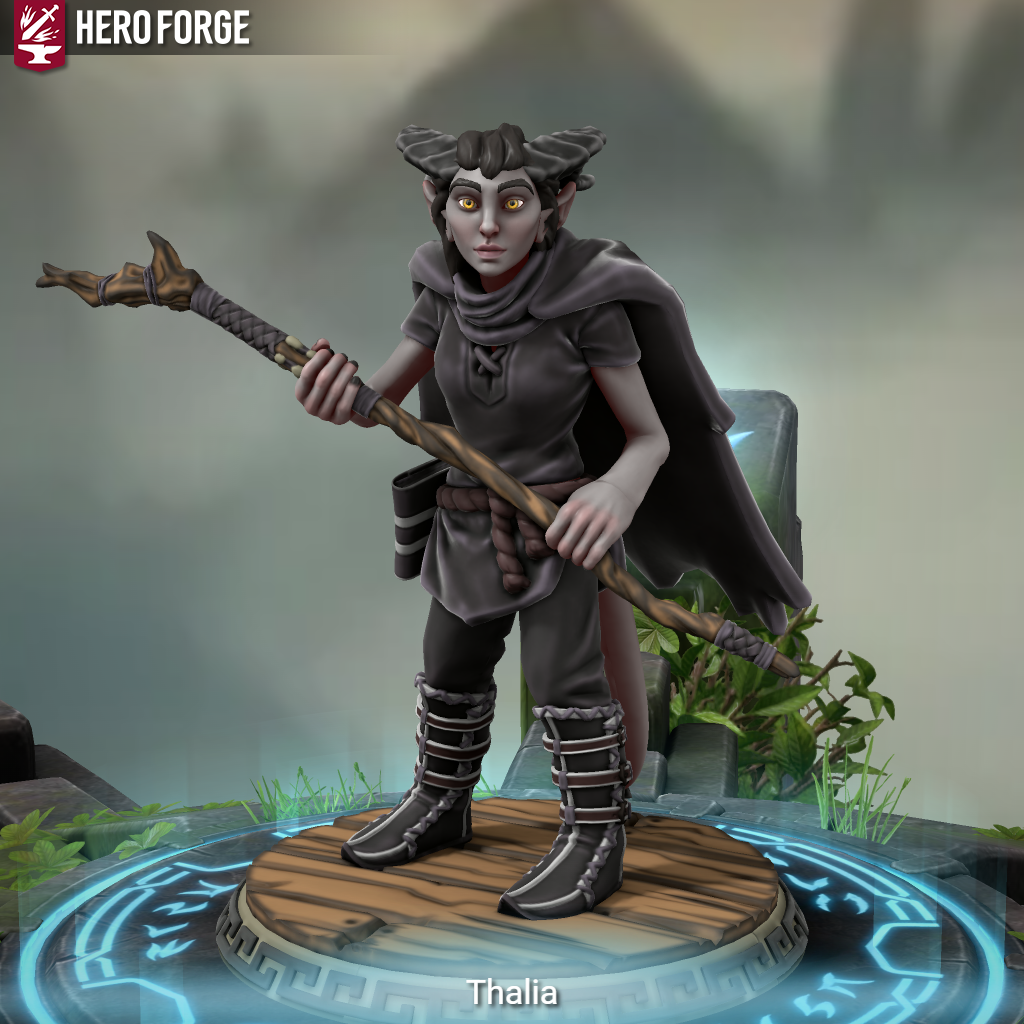
Thalia, a tiefling with a connection to strange and ancient powers, who has seen things mortal eyes probably shouldn’t have:
Brother Sonam, monk of the West Wind, who has traveled far from his homeland on a mission of his own:

Shade, half elf thief, rebel and all-around malcontent, hiding from her past:

If all of this sounds interesting, I hope to see you soon as we begin our journey!
Table of Contents
CHAPTERS
Book One: The Dark Tide
Chapter One: Thornwalkers
Chapter Two: Retreat to Rooks’ Roost
Chapter Three: Spindle Ford
Chapter Four: Challerain Keep
Chapter Five: The Dark Tide
Chapter Six: The Long Pursuit
Book Two: Shadows of Doom
Chapter One: Captive!
Chapter Two: Grimwall
Chapter Three: The Struggles
Chapter Four: Myrkenstone
Chapter Five: Drimmen-deeve
Chapter Six: Shadows of Doom
Book Three: The Darkest Day
Chapter One: The Gathering
Chapter Two: Encounter at Gunarring Gap
Chapter Three: The Valanreach Long-Ride
Chapter Four: The Iron Tower
Chapter Five: The Darkest Day
Chapter Six: The Journey Home
Chapter Seven: The Raven Book
Foreword, Appendices and Final Thoughts


